




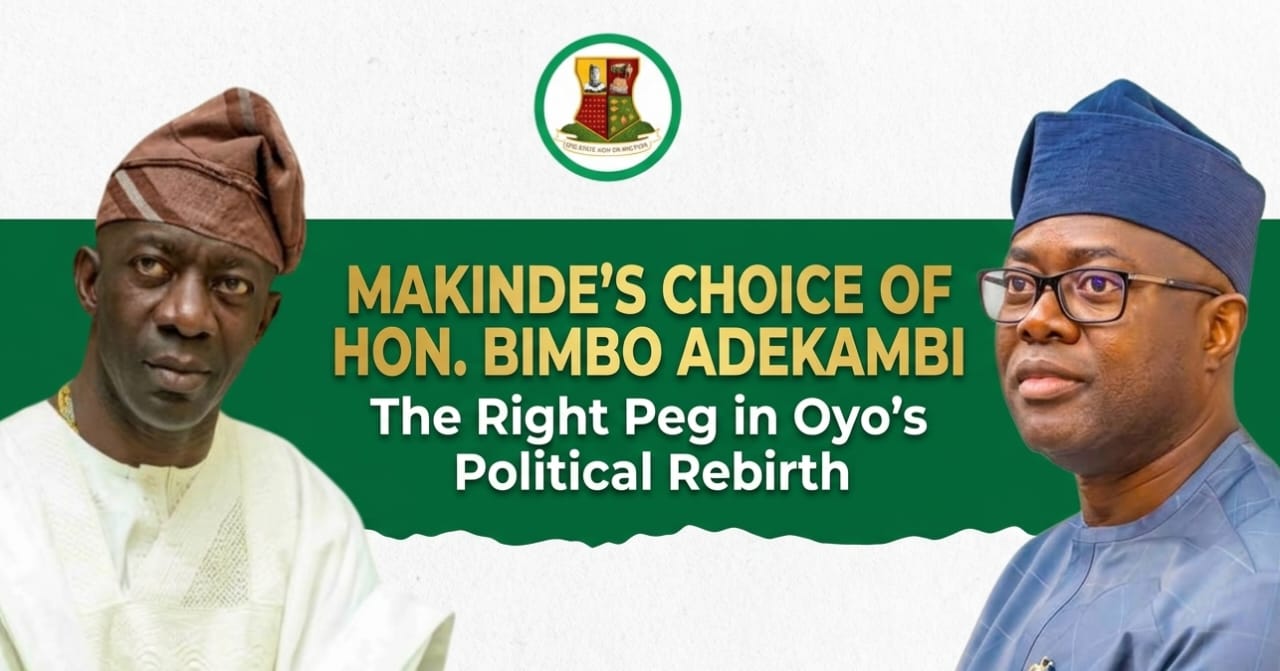

In every political generation, a moment comes when a state must decide whether it wants continuity of progress or a return to uncertainty. Oyo State appears to be approaching that defining moment, and the growing conversation around Bimbo Adekanmbi is steadily reshaping the political atmosphere across the state.

Though official clarifications have emerged that Governor Seyi Makinde is still consulting and has not formally announced a successor, the mere mention of Adekanmbi’s name within serious political conversations has already altered the mood in Oyo politics.
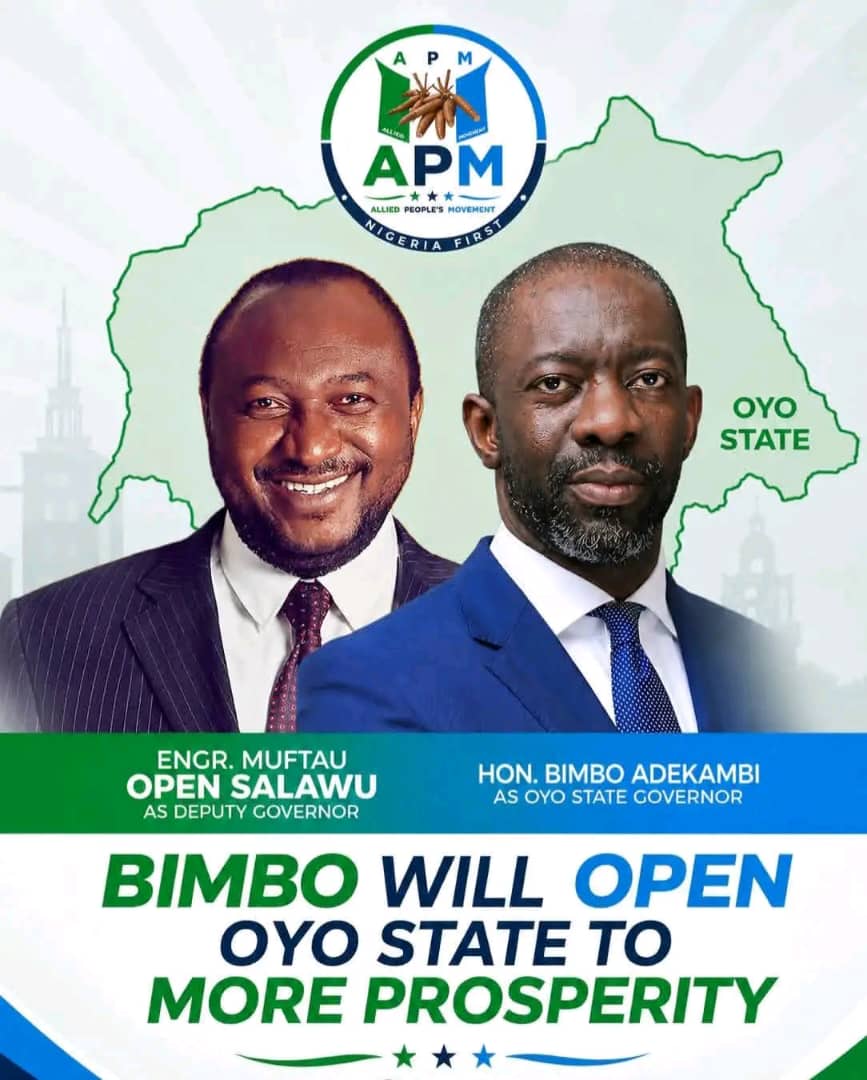
What is even more remarkable is not just the political debate his name has generated, but the unusual calm, hope, and broad acceptability that now trail discussions about his possible emergence.
For many observers, this is not accidental.

It is the result of years of silent preparation, technocratic competence, bridge-building, and humanitarian impact that never relied on loud publicity.

Beyond Politics, A Symbol of Stability
Oyo politics has traditionally been dominated by fierce camps, entrenched loyalties, and bitter rivalries. Yet, in recent weeks, the conversation surrounding Adekanmbi has done something rare — it has softened hardened political equations.
Across different divides, there is an emerging realization that his personality carries fewer political scars than many conventional actors. Even among opposition figures, the hostility that usually accompanies succession discussions appears considerably reduced.
That softening did not happen because of propaganda.
It happened because many people already know the man behind the headlines.
Adekanmbi’s background as a finance expert, former banking professional, and former Commissioner for Finance under the administration of the late Abiola Ajimobi has consistently projected him as someone driven more by governance than noise.
Political observers have also linked his rising profile to his recent appointment to oversee the Ibadan Airport upgrade project, one of the signature infrastructure efforts associated with the Makinde administration.
To many citizens, that appointment was more than administrative responsibility; it was interpreted as a vote of confidence in competence.
And competence remains one of the strongest currencies in modern governance.
The Youth Dimension: Why Young People Are Paying Attention
Perhaps the strongest emotional energy behind Adekanmbi’s growing acceptance comes from the youths.
For years, many young people in Oyo State have complained about being used during elections but ignored after power is secured. They have long desired leadership that listens, includes, and understands modern realities.
Now, many believe this could finally be their moment.
There is an increasing sentiment across political discussions that Oyo may be entering a new era where intellectual capacity, accessibility, and practical governance matter more than traditional political aggression.
For many youths, Adekanmbi represents that transition.
Not necessarily because he is the youngest politician in the race, but because his style appears more aligned with the aspirations of a younger generation that values innovation, inclusion, and measurable results over political theatrics.
The phrase “Youth O’Clock” is beginning to resonate more strongly because many young people see in him a leader whose governance approach may create more room for their voices, ideas, and participation.
And in truth, modern politics is no longer won by intimidation alone.
It is increasingly won by inspiration.
A Humanitarian Without Noise
One major reason the conversation around Adekanmbi has gained emotional traction is the growing number of personal testimonies emerging from ordinary people.
Unlike politicians who build public relations machinery around every act of kindness, many beneficiaries of his humanitarian gestures often tell their stories quietly and independently.
That distinction matters.
In Nigeria’s political environment, philanthropy is often performed for cameras. But when people repeatedly describe acts of support that happened without media attention, it creates a different kind of credibility.
This is why many people describe him as someone whose humanitarian life was never about noise, but necessity.
To struggling families, students, community groups, and vulnerable individuals who have benefitted from his support over the years, he is not merely a political figure. He is someone they believe understands human pain beyond campaign seasons.
And politics, at its best, is supposed to be about people.
The Makinde Factor and the Search for Continuity
Whether officially declared or not, discussions around succession in Oyo State naturally revolve around continuity.
Governor Makinde’s administration has built a reputation around infrastructure renewal, education reforms, road construction, agribusiness expansion, and institutional governance.
The fear among many citizens is simple: after visible progress, who can sustain the momentum without dragging the state backward into political instability?
That question is one of the reasons Adekanmbi’s name continues to dominate conversations.
Supporters believe his technocratic background, financial expertise, and experience within government position him as someone capable of sustaining institutional progress rather than dismantling it.
Even critics who disagree politically often acknowledge his administrative capacity.
And in leadership conversations, that acknowledgment is important.
Because governance is too serious to be reduced to slogans alone.
A Candidate Already Changing Conversations
Perhaps the most significant thing about Adekanmbi’s growing profile is this: even before any official declaration, he has already succeeded in changing conversations.
He has shifted debates from mere political survival to discussions about competence, temperament, inclusion, and continuity.
He has made many opposition voices less combative.
He has given many undecided citizens reason to listen.
He has rekindled belief among sections of the youth population.
And he has gradually built a rare perception in Nigerian politics — that of a man many people believe can unite different interests without deepening divisions.
That alone is politically powerful.
The Road Ahead
Politics remains unpredictable, and Oyo’s political future will ultimately be decided by consultations, party structures, negotiations, and the will of the people.
But one truth is becoming increasingly difficult to ignore: the growing acceptance of Bimbo Adekanmbi is not built merely on political endorsement rumours.
It is being built on perception, competence, temperament, and years of quiet impact.
In moments of political transition, societies often search for leaders who can calm tensions while inspiring confidence.
And for many people watching the unfolding political landscape in Oyo State today, Adekanmbi appears to fit that description.
If Oyo truly seeks a political rebirth anchored on competence, continuity, youth inclusion, and humane leadership, then many now believe that Governor Seyi Makinde may indeed have found the right peg for the right hole.