



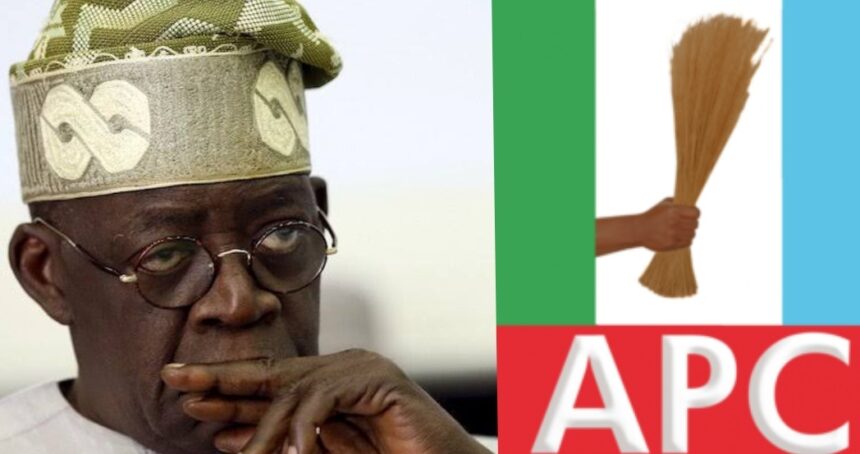

A prominent Yoruba socio-cultural organization, Iyonda Yoruba, has issued a strong and passionate call to all Yoruba people across the six states of the Southwest and beyond to reject the All Progressives Congress (APC) at the polls, declaring that the time has come to end the cycle of hardship, hunger and hopelessness that has defined life for millions of Nigerians under the current administration.

In a comprehensive statement released on Monday and signed by its leadership, Alagbe Bashiru, the group said the 2027 general election is not just another election, but a referendum on survival, dignity, and the future of Yorubaland. The group declared that continuing to vote for a party that has brought untold suffering to the people would amount to reinforcing failure.
“Let’s end this. We shouldn’t reinforce failure,” the group said. “For too long, we have endured, we have adjusted, we have made excuses. But endurance without hope is not resilience, it is self-punishment. Yorubaland must speak with one voice and say enough is enough.”
A Country Blessed, A People Struggling

At the heart of the group’s message is a painful contradiction that every Nigerian market woman, student, driver, farmer and civil servant knows too well, Nigeria is a country blessed with abundant natural resources, yet its people are among the most economically squeezed in the world.
Iyonda Yoruba drew comparisons with other oil-producing nations to illustrate what it described as a failure of leadership and a lack of compassion for the Nigerian people.
The group noted: “A litre of fuel in Libya costs ₦32, while the minimum wage in the country is $208, equivalent to approximately ₦276,000. In Saudi Arabia, a litre of fuel costs approximately ₦823, while the estimated monthly minimum wage is ₦1.4 million. Norway, another oil-producing country, provides its citizens with numerous benefits funded by revenue from its oil resources.
In Nigeria, however, the minimum wage is ₦70,000, while a litre of fuel costs between ₦1,300 and ₦1,900 in some places. That minimum wage amounts to a mere $52. A young man flipping burgers at McDonald’s in the United States earns more than a Nigerian bank manager. Anyone earning ₦100,000 a month in Nigeria is still struggling to make ends meet and may be closer to the poverty line than their counterparts in these countries.
But does the government care? How can millions of Nigerians be struggling to survive in a country blessed with abundant natural resources?”
According to the group, these figures are not just statistics. They represent the daily reality of families who cannot afford to cook a decent meal, transport their children to school, or pay for basic medication.
The Libyan Example: Oil For The People
Iyonda Yoruba explained that Libya, despite years of political instability, has maintained a system where the proceeds of its oil wealth directly cushion its citizens. The group said that at ₦32 per litre, fuel in Libya is almost free, and with a minimum wage of $208, which is about ₦276,000, an average Libyan worker can afford transportation, food, and housing without falling into debt. The fuel subsidy in Libya is not seen as a waste, but as a birthright — the people own the oil, so the people must benefit from it.
The Saudi Example: Wealth With Structure
In Saudi Arabia, the group noted, a litre of fuel costs around ₦823, but the minimum wage is pegged at an equivalent of ₦1.4 million monthly. More importantly, Saudi citizens enjoy heavily subsidized housing, free education, free healthcare, and interest-free loans to start businesses. Oil money is not just shared, it is structured to create a dignified life for the citizen.
“The Saudi government understands that oil will not last forever, but while it lasts, it must build a nation where its people can live with pride. They invest in their people,” the statement said.
The Norwegian Example: Saving For The Future
The group also pointed to Norway, a country with only about 5.5 million people but with one of the largest sovereign wealth funds in the world, valued at over $1.6 trillion, all funded from oil and gas revenues. Norway charges market price for fuel, but every kobo earned is accounted for. Its citizens enjoy free world-class education, free healthcare, unemployment benefits, child support allowances, and a pension system that guarantees old age with dignity.
“In Norway, oil is a blessing that touches every home. In Nigeria, oil has become a curse that impoverishes every home,” Iyonda Yoruba lamented.
The Nigerian Reality: Poverty In The Midst Of Plenty
Bringing the comparison home, the group painted a grim picture of life under the APC government. With a minimum wage of ₦70,000, which at current exchange rates is just $52, a Nigerian worker earns less in a month than what a teenager earns in a few days doing menial jobs abroad.
The group said the removal of fuel subsidy without adequate palliatives or a functional public transport system has crippled small businesses, doubled the cost of food, and pushed millions more into poverty.
“How do you explain a situation where a litre of fuel costs ₦1,300 to ₦1,900, and the minimum wage is ₦70,000? If a worker buys 50 litres of fuel, his entire monthly salary is gone. What will he use to pay rent? What will he use to feed his children? What will he use to pay school fees?” the group asked.
The organization said that today, anyone earning ₦100,000 a month in Nigeria, a sum that would have been considered middle-class a few years ago, is now living on the edge of poverty. Transport fares have tripled, house rents have doubled, food inflation is over 40 percent, and the naira has lost more than 70 percent of its value.
“A young man flipping burgers at McDonald’s in the United States, a job that requires no certificate, earns $12 to $15 per hour. In one week, he earns more than a Nigerian bank manager, a university lecturer, or a police officer earns in a month. This is not because Americans are more hardworking than Nigerians. It is because their system works and ours has been deliberately broken,” the group stated.
Yorubaland Must Remember Who It Is
Iyonda Yoruba said Yorubaland has a history that makes the current suffering even more unacceptable. The group recalled the era of Chief Obafemi Awolowo, whose Action Group government introduced free primary education, free healthcare, minimum wage that had value, farm settlements that created jobs, and industrial estates that made the Western Region the fastest-growing economy in Africa in the 1950s and 60s.
“Awolowo used cocoa money to build schools, not to build personal estates in Dubai. He used our common wealth to educate our children, not to impoverish them. That is the Yoruba ethos — Omoluabi, not greed. Ileri, not propaganda,” the group said.
The organization argued that Yorubaland, as the home of progressive politics in Nigeria, cannot afford to be the anchor for a party that has moved the country from the top to the bottom in every human development index.
“What example are we setting for our children? That we celebrate suffering? That we defend hunger because our party is in power? That we keep quiet when our mothers can no longer afford garri? No. True Omoluabi confronts injustice, even if it is committed by his own kinsman,” the statement added.
Why The Call To Vote Out APC
The group listed several reasons why it believes the APC must be voted out in Yorubaland:
One, Economic Hardship: From fuel price to food price to school fees, life has become unbearable for the average family. Businesses are closing daily because they cannot afford diesel.
Two, Loss of Value and Dignity: The naira has collapsed, making Nigerian labour one of the cheapest in the world. A professor’s salary can no longer buy a bag of rice and pay rent in the same month.
Three, Youth Hopelessness: Thousands of young Yoruba graduates are jobless, riding okada, or risking their lives to Japa through the desert and the Mediterranean Sea because there is no hope at home.
Four, Insecurity: Farmers in Oke-Ogun, Ijesaland, Yewa, and Akoko can no longer go to farm for fear of kidnappers. Food that should be cheap is expensive because farmers have abandoned their farms.
Five, Betrayal of Progressive Ideals: The APC came to power on the promise of change, restructuring, and prosperity for all. Today, Nigeria is more divided, more indebted, and more impoverished than it was in 2015.
The Power Is In Our Hands
Iyonda Yoruba emphasized that voting is not just a right, but a tool for survival. The group urged market women, artisans, students, farmers, teachers, drivers, and professionals to organize themselves from ward to ward, from local government to local government.
“This is not about PDP, APM, ADC, NDC, or any other party. This is about us versus hunger. Us versus hopelessness. Us versus a system that tells a mother to manage ₦70,000 while fuel is ₦1,700 per litre,” the group said.
“We are not asking people to vote blindly. We are asking them to vote wisely. Look at your life in 2015 and look at your life now. Look at your children’s plate. Look at your rent receipt. Look at your mother’s health. If you are better off today than you were before, then continue. But if you are not, then let’s end this. We shouldn’t reinforce failure.”
The group concluded by calling on traditional rulers, religious leaders, youth organizations, and women groups in Yorubaland to speak out and not remain silent in the face of suffering.
“Silence in the face of injustice is not neutrality, it is complicity. Our forebears did not keep silent when things went wrong. They spoke, they acted, they defended the people. This generation must do the same. The 2027 election is our opportunity to reclaim our dignity and rebuild a Yorubaland where a ₦70,000 wage can actually feed a family, where fuel price has meaning, and where oil wealth finally works for the people who own it.”