






In the past few days, certain All Progressives Congress (APC) apologists in Oyo State individuals who have recently received vehicular and financial inducement have gone into overdrive, pushing the narrative that Hon. Bimbo Adekanmbi is being positioned as Governor ‘Seyi Makinde’s surrogate.

Eager to justify their largesse, they have deliberately amplified this rumour in selected circles, claiming that Makinde, now approaching the end of his constitutionally permitted tenure, is quietly preparing to continue governing the state from the shadows. It is a simple, seductive, and politically convenient allegation. But like most political rumours, it thrives on falsehood rather than fact. When weighed against Makinde’s public statements, his governance philosophy, and Adekanmbi’s technocratic pedigree, the proxy narrative does not merely weaken, it collapses entirely.
Makinde himself has been unequivocal. In August, at the Hijrah 1448 Luncheon in Government House, Agodi, Ibadan, he made one of the clearest declarations by any outgoing Nigerian governor in recent memory: “I won’t be a political godfather to my successor.” He went further, articulating a leadership philosophy that directly rejects the godfather tradition that has shaped politics in many Nigerian states.
According to him, “The essence of political leadership should not be the ability to control those who come after a public office holder, but the willingness to serve humanity and leave behind institutions and structures that can continue to benefit the people.” He also pledged not to interfere in his successor’s decisions.
These are not the words of a man plotting to govern from the shadows; they reflect a leader who believes governance should be institutional rather than personal, and that competence, not control, is the true legacy of leadership.

To understand why the surrogate narrative fails, one must examine Makinde’s governance record, the systems he has built, and the kind of successor those systems require. Across his two terms, Makinde has pursued a quiet but deliberate philosophy: build durable institutions, strengthen administrative capacity, and let competence speak louder than political theatrics. His achievements reflect this approach in a sustained, statewide pattern that has reshaped Oyo State’s governance culture and elevated expectations of what public leadership should look like.
Makinde’s infrastructure agenda has been one of the most transformative in recent Oyo history. The reconstruction of the Moniya–Iseyin Road opened a vital economic corridor between Ibadan and Oke Ogun, reducing travel time and boosting agricultural trade. The Oyo–Iseyin Road strengthened inter zonal connectivity, while the Iseyin–Ogbomoso Road created a strategic link that binds Oke Ogun to Ogbomoso and enhances economic integration across the northern zones of the state.
He also embarked on one of the most ambitious infrastructural projects in the state’s history: the Ibadan Circular Road. Designed to decongest the city, attract investment, and modernize urban mobility, the Circular Road represents a long-term economic artery that will shape the future of Oyo State’s capital for decades.
Complementing these flagship projects is the reconstruction of over 300 kilometres of roads across Ibadan and other towns, a sweeping renewal effort that demonstrates his commitment to statewide development rather than isolated showcase projects.
Makinde’s education reforms have been equally significant. He abolished school fees in public primary and secondary schools, recruited thousands of teachers, and renovated classrooms across the state. Enrolment increased, dropout rates declined, and public schools regained dignity. In a state with a large youth population, these reforms signalled a commitment to human capital development that transcends political cycles.
His health reforms strengthened the foundation of public healthcare. The upgrade of Adeoyo Maternity Hospital, rehabilitation of primary healthcare centres, and expansion of the Oyo State Health Insurance Scheme brought affordable healthcare to families long excluded from the system. These reforms are not glamorous, but they are essential.
Makinde’s establishment of the Amotekun Corps became a symbol of proactive governance and regional collaboration. It required political courage and administrative clarity, qualities that define his leadership. But he did not stop at community-based security. He expanded the state’s surveillance capacity by acquiring two surveillance aircraft, a bold investment that signalled a shift toward modern, technology-driven security infrastructure. This has strengthened aerial monitoring, improved response capabilities, and demonstrated a willingness to innovate where many subnational governments remain hesitant.
His commitment to long term economic planning is also evident in the upgrade of the Ibadan Airport. By improving runway capacity, expanding facilities, and enhancing operational standards, Makinde positioned the airport as a regional aviation hub capable of supporting increased passenger traffic, cargo movement, and business travel. The upgrade is not merely a construction project; it is a strategic investment in Oyo State’s future competitiveness, tourism potential, and economic integration with national and international markets.
These achievements form the backbone of Makinde’s governance identity. They also explain why he would naturally support a successor capable of sustaining and expanding this momentum. Continuity, in this context, is not about preserving personalities or entrenching hegemony; it is about ensuring the continued development of the state. Makinde’s reforms are systemic. Systems do not mature overnight. They require consistent leadership, steady policy implementation, and a successor who understands the architecture of governance. Economic momentum cannot survive abrupt disruption. Institutional strength requires stability. Security architecture needs continuity. Public trust is built over time. In this light, Makinde’s support for Adekanmbi is not about perpetuating control, it is about ensuring that the systems he built do not collapse under a successor who lacks the competence to sustain them.
Adekanmbi embodies this competence. During his tenure as Commissioner for Finance, he strengthened financial reporting, improved budgeting processes, and helped stabilize Oyo State’s fiscal posture at a time when many subnational governments were struggling with debt and revenue volatility.
He has also confronted the surrogate narrative head on. Appearing on the Arise News Morning Show in September, he rejected the suggestion with measured clarity: “I do not have any godfather apart from the people of Oyo State. I will take responsibility for every decision I make.” He added: “I’m no surrogate to Governor Makinde. The governor made it clear that I shouldn’t inherit his enemies.” And then, with the confidence of someone whose career has been built on competence rather than political dependency, he said: “I’m owning every action I take as governor, just as I have always owned my actions in life. I’m prepared. I have my own manifesto and strategy.”
These remarks reinforced what his record already suggests: he is not seeking office to serve as anyone’s proxy, but to serve with the autonomy and expertise that have defined his professional journey.
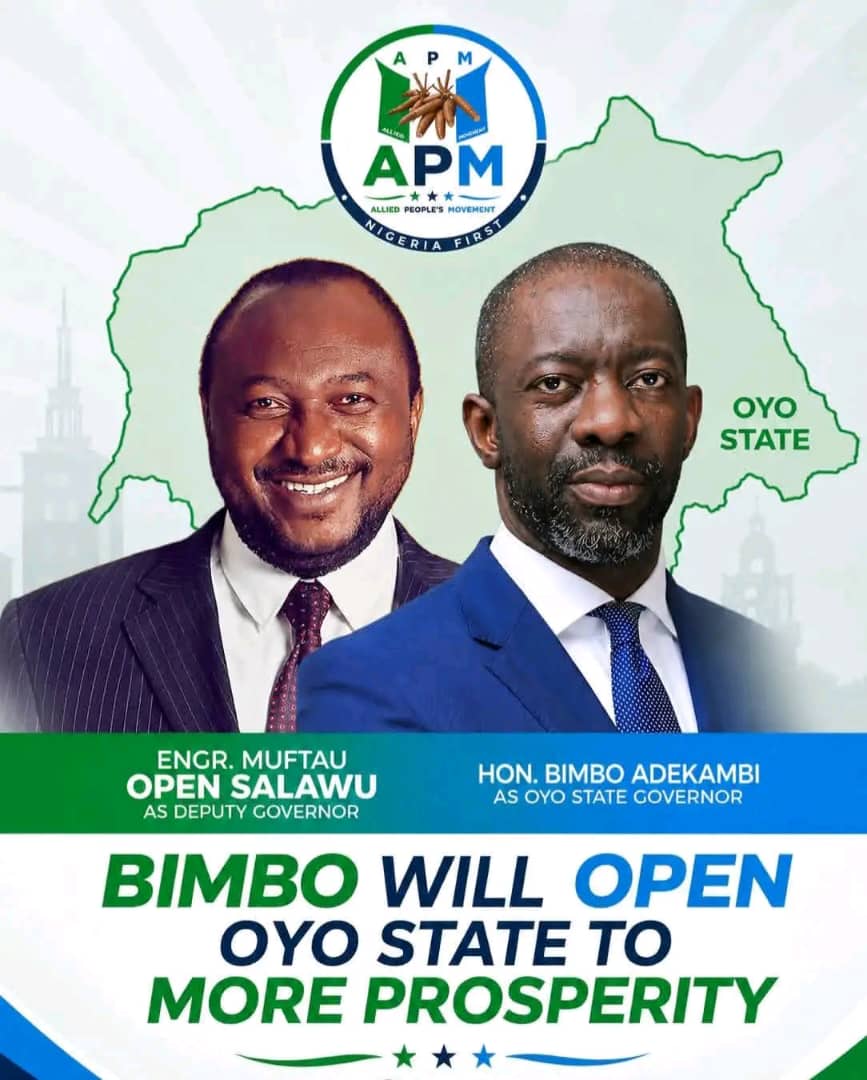
Yet Adekanmbi’s appeal is not merely technocratic. It is geographic, cultural, and political – a rare statewide identity that few aspirants can claim. His family roots stretch across Ibadan, Iseyin in Oke Ogun, and Oyo town, giving him organic ties to three of the state’s most influential zones. His running mate, Engr. Mufutau Open Salawu, hails from Ogbomoso, adding another layer of regional balance. His strong relationship with influential figures in Ibarapa completes a statewide mosaic that positions him as a bridge across communities, traditions, and political tendencies.
This matters in Oyo State, where political legitimacy is often shaped by geography as much as ideology. Adekanmbi’s identity is not sectional; it is integrative. He is not a candidate who must manufacture acceptance in certain zones, he already has it. This statewide spread gives him a political posture that is independent, grounded, and difficult to caricature as a proxy.
And this is precisely why Makinde’s support for him cannot be reduced to hegemonic ambition. A governor seeking to “rule by proxy” would typically choose someone dependent, inexperienced, or confined to a narrow political base. Adekanmbi is the opposite: strong, widely accepted, and capable of building his own legitimacy. His administrative record gives him credibility; his statewide identity gives him reach; his technocratic grounding gives him stability.
In many ways, Adekanmbi represents the logical extension of Makinde’s governance philosophy. He understands the systems Makinde has built. He understands the importance of fiscal discipline, the value of data driven policy, and the need for statewide inclusion. He is not a candidate who needs to be controlled; he is a candidate who understands the architecture of governance well enough to sustain it.
This is what makes him the embodiment of continuity without control. He can protect the integrity of Makinde’s reforms without compromising his own integrity. He can maintain momentum without sacrificing independence. He can inherit a governance structure without inheriting a political leash. Adekanmbi’s emergence, therefore, is not a sign of Makinde’s desire to extend his influence; it is a sign of Makinde’s desire to extend competence, to ensure that the systems built over eight years do not collapse under a successor who lacks the capacity to maintain them.
In a political climate where succession often means rupture, Adekanmbi represents continuity without stagnation, stability without subservience, and progress without puppetry.
Makinde’s support for Adekanmbi is not an act of political dominance; it is an act of political maturity. It reflects a belief that leadership should outlive the leader, that institutions should outlast administrations, and that competence – not control – is the most valuable inheritance a governor can leave behind. In a political environment often defined by personal dominance and shadow influence, Makinde’s stance is unusual. And his support for Adekanmbi, when viewed through the lens of continuity without control, may well be one of the most consequential decisions shaping Oyo State’s political future.
So, the people of Oyo State will do well to support Honourable Bimbo Adekanmbi to sustain the momentum of allround development across every zone of the state, which Governor Makinde has firmly established since May 2019.
Dr Olanrewaju is Co-Director (Media and Publicity), Oyo State APM Governorship Campaign Council