




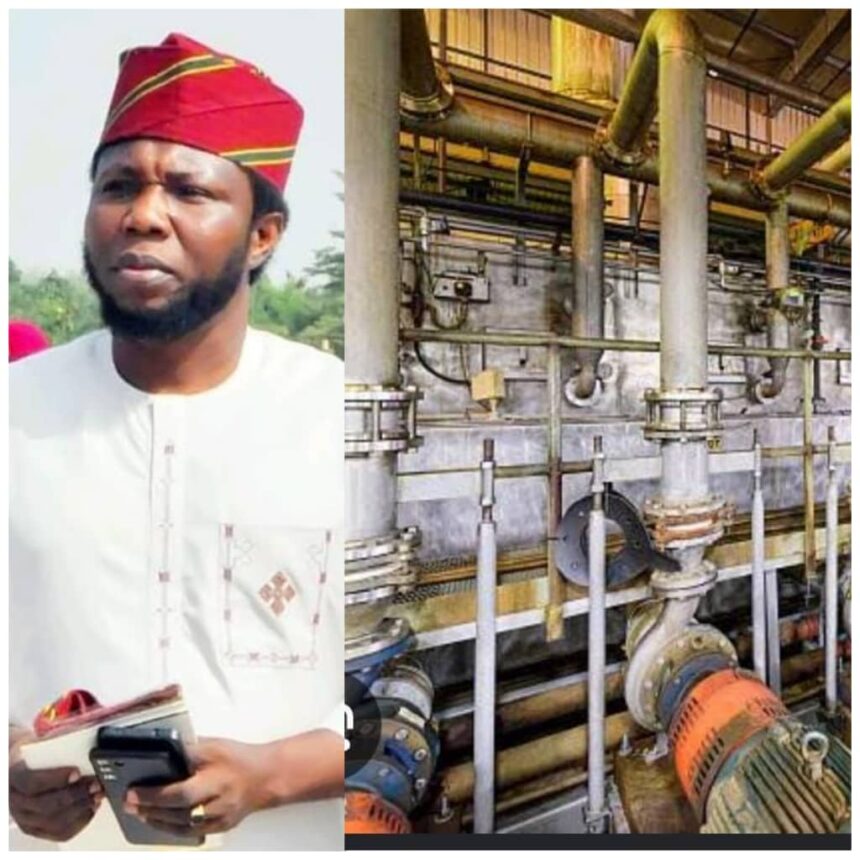

The National Association of Oduduwa Students (NAOS) calls on the Federal Government of Nigeria, the National Assembly, state governments, the organised private sector and the Nigerian people to embrace a deliberate national economic direction that prioritises manufacturing, industrialisation, local production and value addition over excessive dependence on imported finished goods and an economy driven largely by buying and selling.

As a nation blessed with abundant human resources, agricultural potential, mineral deposits, crude oil, natural gas and a large consumer market, Nigeria must begin to maximise its domestic productive capacity. We cannot continue to depend heavily on foreign countries for products that can be manufactured, processed, assembled and produced locally.

An economy that primarily consumes what other nations produce will struggle to create sufficient productive employment for its growing population. Nigeria must therefore move beyond being predominantly a consuming economy and become a competitive producing economy.

THE DANGOTE REFINERY: A PRACTICAL EXAMPLE OF INDUSTRIAL TRANSFORMATION.


The establishment of the Dangote Petroleum Refinery by Dangote Industries Limited demonstrates the enormous possibilities of large-scale industrial investment in Nigeria.
With an initial nameplate refining capacity of 650,000 barrels of crude oil per day, the refinery represents a major investment in Nigeria’s industrial and energy infrastructure. Its development demonstrates what Nigerian capital, entrepreneurial vision, technical expertise and long-term investment can achieve when directed towards domestic production.

According to the International Monetary Fund’s 2025 assessment, the refinery involved an investment of approximately $20 billion, equivalent to about 5.5 per cent of Nigeria’s 2023 GDP. The IMF also projected that the refinery could generate substantial employment, stimulate investment and support economic growth, with approximately 150,000 direct and indirect jobs in connected sectors associated with the project.
This is the kind of productive investment Nigeria needs across different sectors of its economy.
The refinery’s significance extends beyond petroleum products. It creates opportunities across transportation, logistics, engineering, construction, maintenance, distribution, petrochemicals and other supporting industries.
It also demonstrates how local industrial capacity can reduce dependence on imported petroleum products, conserve foreign exchange that would otherwise be spent on imports, strengthen domestic supply chains and create opportunities for Nigerian businesses.
The United States Energy Information Administration reported in August 2026 that Nigeria’s seaborne petroleum product imports had fallen from nearly 400,000 barrels per day in 2023 to less than 130,000 barrels per day in the second quarter of 2026, alongside increased domestic supply and exports. This demonstrates the potential economic impact of investing in domestic refining capacity.
NAOS recognises Dangote Industries Limited as an important example of the contribution that private-sector industrial investment can make to national development.
One of our greatest economic concerns is the gap between what Nigeria consumes and what it produces.
A Development Bank of Nigeria research note published in October 2026 reported that Nigeria’s manufactured imports reached approximately ₦35.99 trillion in 2025, while manufactured exports stood at approximately ₦2.50 trillion.
The figures reveal a significant imbalance between imported manufactured products and the value of manufactured goods exported by Nigerian businesses.
This should be a wake-up call for policymakers, investors and the private sector.
Rather than allowing the domestic market to depend excessively on imported finished products, Nigeria must create an enabling environment for local manufacturers to produce competitive goods, expand their operations and employ more Nigerians.
We must understand that manufacturing creates employment opportunities at different levels of the production chain. From factory workers to engineers, economists, accountants, administrators, technicians, researchers, logistics professionals and fresh university graduates, industrial development provides a broad range of employment opportunities.
Our fresh graduates should not have to depend solely on government recruitment or the limited vacancies available in the traditional corporate sector. A growing manufacturing economy can create new career opportunities, encourage innovation, support entrepreneurship and give young Nigerians the opportunity to contribute meaningfully to national development.
NAOS respectfully calls on the Federal Government of Nigeria to adopt a comprehensive national industrialisation strategy that will make manufacturing a central pillar of economic recovery and sustainable development.
We specifically
recommend:
- Affordable Financing for Manufacturers
Government should strengthen access to affordable, long-term financing for Nigerian manufacturers, industrial investors, small-scale producers and indigenous entrepreneurs through development banks and appropriate financial institutions. - Reliable Electricity and Industrial Infrastructure
Manufacturing cannot thrive where businesses spend excessive resources generating their own electricity. Government must improve power supply, roads, railway connectivity, ports, water infrastructure and industrial facilities. - Tax Incentives for Genuine Local Production
Companies investing in factories, technology, research, local processing and employment generation should enjoy appropriate tax incentives and policy support. Such incentives must be transparent and tied to measurable productive outcomes. - Graduate Employment and Industrial Skills Development
Government should establish stronger partnerships between universities, polytechnics, technical institutions and manufacturing companies to provide industrial training, internships, apprenticeships and employment pathways for fresh graduates. - Local Content and Made-in-Nigeria Promotion
Government institutions, public agencies and private organisations should promote quality Nigerian-made products through transparent procurement policies and appropriate local-content frameworks. - Support for Indigenous Industries
The government must support industries in agriculture, textiles, pharmaceuticals, petrochemicals, automobile assembly, food processing, construction materials, technology and other productive sectors where Nigeria has the potential to compete. - Policy Consistency and Investor Confidence
Investors need predictable policies, transparent regulations, security of investment and an efficient business environment. Government must avoid arbitrary policy changes that discourage long-term industrial investments.
NAOS also appeals to Nigerian business leaders, wealthy individuals, financial institutions and the organised private sector to look beyond short-term commercial returns and invest more substantially in productive industries.
Trading and importation remain legitimate components of economic activity. However, an economy cannot achieve sustainable industrial development when the importation and distribution of finished goods consistently overshadow domestic production.
We need more factories, processing plants, industrial parks, technology hubs, pharmaceutical production facilities, textile industries, food-processing companies and other businesses that manufacture goods locally.
The success of Dangote Industries Limited should encourage more Nigerian entrepreneurs to think on a larger industrial scale.
Nigeria needs more indigenous industrial champions capable of creating jobs, transferring technology, developing local suppliers and competing in international markets.
To Nigerian students, graduates and young entrepreneurs, the future of our economy must not be limited to the pursuit of white-collar employment alone.
We must embrace innovation, technical skills, entrepreneurship, research, industrial development and productive enterprise.
However, this responsibility cannot be placed on young people alone. Government and the private sector must create the enabling environment, access to capital, infrastructure and opportunities required for young Nigerians to succeed.
Our graduates deserve an economy that creates opportunities for their knowledge, qualifications, talents and professional abilities.
The economic future of Nigeria depends significantly on our ability to produce, process, manufacture and export.
We cannot continue to export raw materials, import finished products, spend scarce foreign exchange on avoidable imports and expect sustainable economic prosperity without strengthening our domestic industries.
The Dangote Refinery has demonstrated that ambitious industrial investment is possible in Nigeria. Its example should inspire a broader national commitment to manufacturing across all sectors.
NAOS believes that prioritising manufacturing will contribute to job creation, foreign exchange conservation, industrial competitiveness, technology transfer, economic diversification and long-term national development.
We therefore urge the Federal Government to make industrialisation a national economic priority and encourage Nigerians to patronise quality locally manufactured products.
LET US BUILD FACTORIES, NOT JUST MARKETS. LET US CREATE JOBS, NOT JUST IMPORT GOODS. LET US PRODUCE FOR NIGERIA AND EXPORT TO THE WORLD.
Nigeria must move from a consuming economy to a productive economy.
A stronger Nigeria begins with a stronger productive sector.
Signed:
Comrade Olalere Benedict Adetunji
National President
National Association of Oduduwa Students (NAOS)/ Economics Student of Ajayi Crowther University, Oyo.
07061830662