






Whenever Governor Seyi Makinde speaks about the hardship caused by fuel subsidy removal, critics and opposition supporters often ask: “What has he done differently since government allocations have increased?”

That is a fair question, and the answer should be based on verifiable facts.
Immediately after subsidy removal, Seyi Makinde approved a wage award to cushion the economic hardship faced by workers and pensioners pending the implementation of a new minimum wage. He approved ₦25,000 monthly for workers and ₦15,000 monthly for pensioners. He also extended the support to serving NYSC members posted to Oyo State Agencies.

Beyond the temporary wage award, Seyi Makinde later approved a new minimum wage of ₦80,000 for workers.

But the major point is employment.

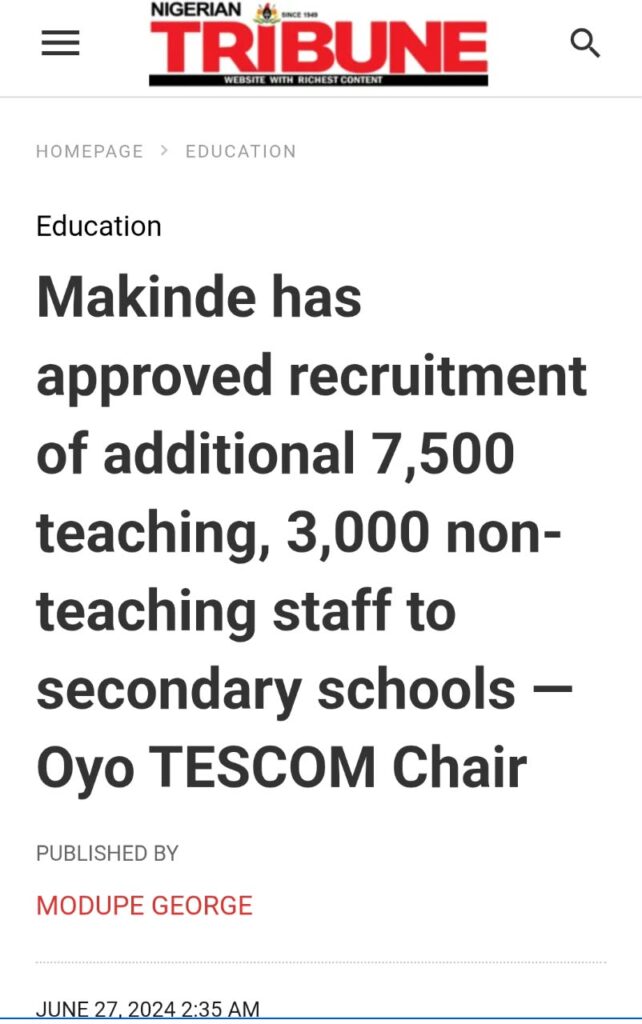
Since 2024, Seyi Makinde has approved recruitment across several sectors, including TESCOM, SUBEB, Oyo State Fire Service, Amotekun Corps, Health Workers, the Local Government Service Commission and the Civil Service Commission.

These are not just numbers on paper. Behind every successful recruitment is a Nigerian who now has a source of income and a family that may have one less burden to carry.
But here is the question I believe Nigerians should also be asking: With the substantial increase in federal revenue and FAAC allocations following subsidy removal, how many Nigerians has the Federal Government itself recruited since 2023?
What is the total number of new federal workers employed across the ministries, departments and agencies? How much of the increased federal revenue has gone into direct job creation and putting more money into the hands of ordinary Nigerians?
These questions are not about attacking the Federal Government. They are legitimate questions about accountability and how public resources are being converted into opportunities for citizens.
If state governments are receiving increased allocations, Nigerians should be able to examine what each government is doing with those resources. The same standard should apply to the Federal Government.
For many families in Oyo State, the impact of Seyi Makinde’s recruitment programmes is personal. The beneficiaries are our friends, relatives, neighbours and community members. They are people who can now earn a salary, support their families and plan their lives with greater stability.
And this is the main reason many of us want Seyi Makinde to have the opportunity to serve Nigeria at the national level.
Our support is not based only on slogans. It is also based on what we have seen happen around us. We have seen interventions for workers and pensioners, employment opportunities for thousands of people, and recruitment across education, healthcare, security, the civil service and local government.
If this approach can be applied on a national scale, the potential impact on Nigerian families would be significant.
Seyi Makinde has given his supporters something they can point to and say: “We have seen this approach at work in Oyo.”
That is why, for many of us, the conversation is no longer simply about who should occupy an office. It is about the kind of governance and economic opportunities we want to see extended to more Nigerians.
The records are there. The programmes are there. The beneficiaries are there.
Now, let Nigerians examine the facts, compare the records and make their own informed decision about the future of the country.