

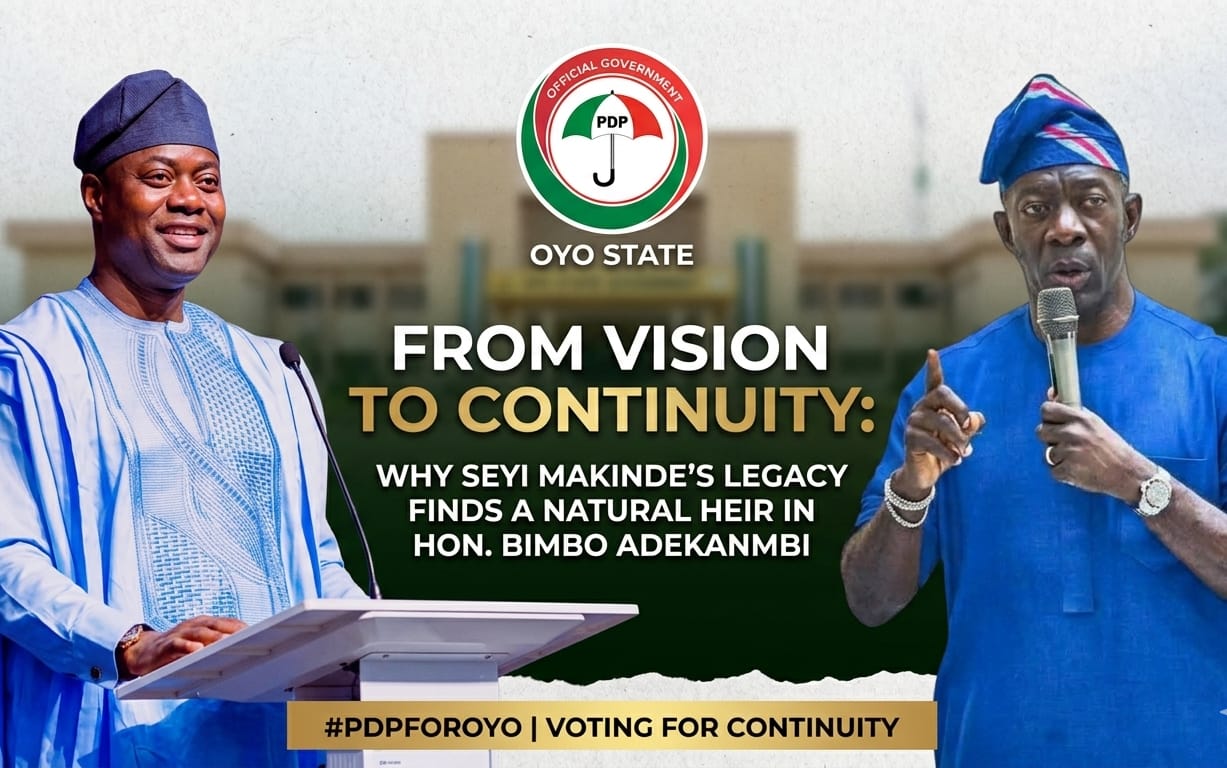

In the evolving political story of Oyo State, few leaders have redefined governance as boldly as Seyi Makinde. Rising from a background rooted in engineering, enterprise, and philanthropy, Makinde’s journey into leadership was never accidental, it was driven by a deliberate desire to reshape governance into something practical, people-centered, and sustainable.
Since assuming office in 2019, his administration has anchored its vision on four key pillars: education, healthcare, security, and agribusiness-led economic growth. These were not mere policy slogans; they became measurable actions that gradually transformed the state.
Across Oyo, roads once neglected began to connect communities again. Strategic infrastructure projects, ranging from major road reconstructions to modern bus terminals, have improved mobility and economic activity. In the agricultural sector, his government attracted over ₦27 billion in private investments, positioning agribusiness as a serious economic driver and creating jobs across rural communities.
Education, too, witnessed a quiet revolution. From reducing out-of-school children to building and renovating classrooms, Makinde’s policies ensured that access to learning was no longer a privilege but a right.

Beyond projects and statistics, however, what truly defines Makinde’s leadership is his governance philosophy, inclusive, data-driven, and focused on long-term impact. His administration introduced innovative funding models like the Alternative Project Funding Approach (APFA), ensuring development continues even in times of financial constraints.

After years of such structured leadership, the question naturally arises: Who can sustain and deepen this trajectory?
This is where Hon. Bimbo Adekanmbi enters the conversation, not just as a political figure, but as a continuation of a tested governance ideology.
Hon. Adekanmbi represents a new generation of leadership that aligns closely with Makinde’s blueprint. His strength lies in grassroots understanding, administrative exposure, and a people-first mindset, qualities that are not accidental but necessary for continuity. While Makinde built systems, the next leader must understand those systems deeply enough to expand them, and Adekanmbi fits that mold.
Where Makinde emphasized infrastructure, Adekanmbi is seen as someone capable of consolidating and maximizing those investments for economic productivity. Where Makinde strengthened agribusiness, Adekanmbi’s approach is expected to deepen value chains and youth participation. And where Makinde focused on inclusive governance, Adekanmbi’s political style reflects accessibility and grassroots connection, critical for sustaining public trust.
Leadership transition is often where progress either accelerates or collapses. Oyo State, having experienced structured governance under Makinde, cannot afford regression. It requires continuity with innovation, a leader who understands the past but is bold enough to shape the future.
Hon. Bimbo Adekanmbi, by political temperament and alignment, appears to embody that balance.
In truth, the story is not just about succession, it is about preserving a vision while expanding its frontiers. Makinde laid the foundation of a modern Oyo State; the next leader must build the structure.
And in that unfolding narrative, Adekanmbi is increasingly seen not just as a successor, but as a natural extension of a legacy already in motion.
